If you require a dependable barrier to contain liquids, avoid leaks or protect the environment, geomembrane liner material is the answer that engineers and builders rely on all over the world. Geomembranes, acting as an impermeable shield, can be used to protect your landfill, mining site, pond and reservoir, and the environment as a whole. But since there are so many different products, how do you get one that will fit your requirements exactly?
In this article we will discuss all about the GEOSINCERE Geosynthetics geomembrane materials - types, advantages, main factors of performance, applications, and the decision-making process. Right after that, you will be ready for the next stage with no doubt.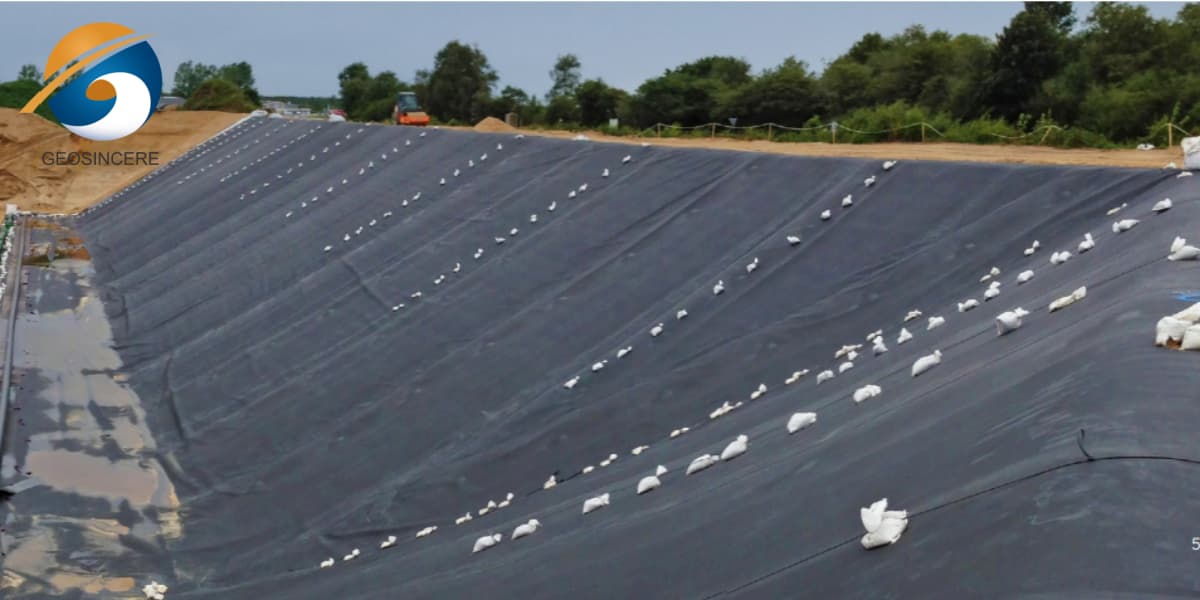
Geomembrane material is a synthetic sheet made of polymers that constitutes a completely sealed barrier. The chief purpose of this material is to prevent fluids, air, or pollutants from transferring from one location to another. You may imagine it as a very sophisticated layer that keeps water in (as in a reservoir) or prevents the release of harmful substances (when it acts as the layer in a landfill).
These geomembrane materials belong to the group of geosynthetics which besides geotextiles (fabric-like, permeable) and geogrids (grid-like for reinforcement) include also geomembranes. Unlike geotextiles, geomembranes are designed to be almost flawlessly sealed, their permeability being so low that it is expressed in terms of centimeters per second to the negative 12th to the negative 14th power.
Today geomembrane liner is made with extrusion processes at a high level of sophistication, being provided with UV stabilizers, antioxidants, and carbon black to guarantee resistance over many years. If a geomembrane is properly laid down and joined (using thermal welding or other methods of seam), the system may last even 50 years or more.
To decide on a geomembrane sheet it is necessary first to have a knowledge of the different polymers and their proprietary blends that are on the market. Each one is distinguished by its specific properties and most suitable applications.
HDPE is undoubtedly the leading hdpe geomembrane material worldwide in terms of the number of applications, with the share of the material in the installations estimated to be about 70–80%. The properties that make it so widely used are its excellent resistance to chemicals, high tensile strength, permeability that is almost negligible, and remarkable stability under UV light (achieved by the presence of 2–3% carbon black). HDPE is manufactured with thicknesses of 0.2 mm to 3.0 mm and roll widths of up to 8 m. The sheet can either be smooth or textured. This material is relatively stiff and requires thermal welding of seams, which is a disadvantage.
- Use it when you have: landfills, mining heap leach pads, tailings ponds, reservoirs, hazardous waste containment, secondary containment.
LLDPE is a highly flexible variety of HDPE. Its density is lower, elongation is higher, and it conforms better to the shape of the ground. Large panels can be folded and fabricated in the shop, thus minimizing field seams. On the other hand, LLDPE is slightly weaker in puncture resistance and has a little lower chemical resistance than HDPE.
- Use it when you have: fish ponds, decorative lakes, uneven terrain, temporary containment, projects where flexibility is more important than maximum strength.
A PVC geomembrane is a kind of flexible, plasticized layer that can be easily installed. It can be pieced together with the help of solvents or adhesive materials, thus making the job of the person installing the membrane quite easier. Besides that, PVC is also relatively cheaper when compared to some other alternatives. On the downside, it has lower chemical resistance, is less stable when exposed to UV rays and the service life is shorter (usually 20 - 30 years ) as a result of the plasticizer migration.
EPDM is a synthetic rubber membrane which is extremely flexible and resistant to the UV rays. It is suitable for cold climates since it keeps its elasticity. Usually, EPDM is delivered as large fabric panels that are pre-assembled, which leads to lesser seams in the field. On the other hand, the material itself is more expensive and the seams may be difficult to rely on (adhesive or tape). Besides that, it is not suited for hydrocarbon or solvent containment.
- Best for: Roof gardens, artificial lakes, decorative water features, cold-weather applications.
Your critical points to keep in mind when you compare geomembrane materials:
- Chemical Resistance: Will the liner be exposed to acids, alkalis, hydrocarbons, or salty water? HDPE offers the greatest chemical resistance.
- Permeability: All geomembranes are very impermeable, however, HDPE/LLDPE (10⁻¹³–10⁻¹⁴ cm/s) do better than PVC (10⁻¹¹–10⁻¹² cm/s).
- Mechanical Strength: HDPE is the top performer in tensile strength and resistance to puncture. LLDPE is stronger than PVC but is weaker than HDPE.
- UV & Weathering Resistance: HDPE with carbon black can still retain >70% of its original strength even after 2,000+ hours of UV exposure. Also EPDM scores high, but PVC deteriorates faster.
- Flexibility & Conformability: LLDPE, PVC, and EPDM can flex even more than HDPE which makes the work of the person doing the installation easier especially if the subgrade is uneven.
- Seaming Method:HDPE and LLDPE need thermal welding (hot wedge or extrusion), and this type of work requires a skilled worker. Solvent welding is going to be used for PVC, a method that is easier but less durable.
- Service Life: HDPE and LLDPE: 50–100 years when buried. PVC: 20–30 years. EPDM: 30–50 years if it is well taken care of.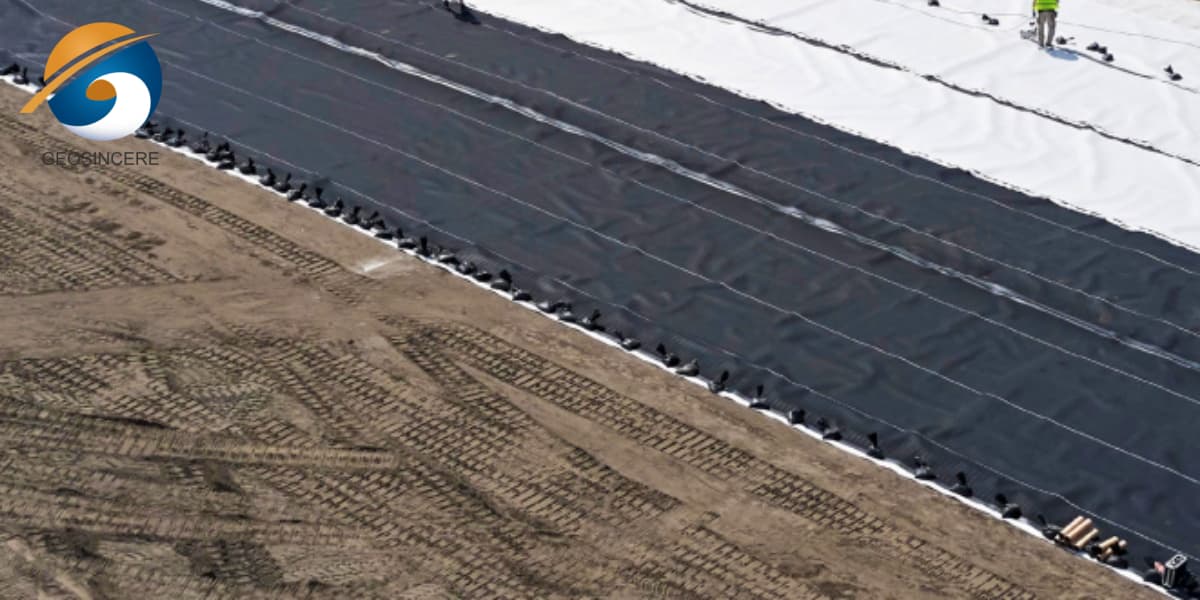
First, let us know exactly what you are planning to store or isolate by using the geo membrane. Get a full chemical analysis of the substances being contained: pH, salinity, presence of aggressive agents. If the system involves strong acids, hydrocarbons, leachate, or industrial solvents, HDPE geomembrane is usually the most reliable choice due to its excellent chemical resistance and long-term stability.
While different industries have their own strict standards for example, landfill projects may require a minimum thickness of 1.5 mm HDPE geomembrane as per environmental protection regulations such as EPA guidelines. Mining and tailings applications may also call for reinforced or double-lined systems depending on risk level and environmental sensitivity.
Check the types of soil on the site as well as the natural features of the landscape. If the subgrade is composed of sharp stones, uneven surfaces or weak soil layers, then one should install a protective layer such as LLDPE geomembrane or nonwoven geotextile cushion that will reduce the possibility of puncture. On the other hand, if someone is working on the steep slopes or unstable areas, it is highly recommended that they use textured HDPE geomembrane because it not only increases the friction between the materials but also helps in stabilizing the slope.
Ask yourself if heavy machinery or construction equipment will work on the liner surface. In these types of situations, thicker membranes like geomembrane hdpe 2mm or thicker are best. Installing a geotextile protective layer will not only increase the puncture resistance but also prolong the service life in situations of high mechanical stresses.
Although the price of HDPE geomembrane raw material is generally the lowest, the welding procedure requires a highly skilled workforce and very strict welding QA/QC, which increases labor cost. LLDPE geomembrane can be prefabricated into larger panels that reduce the welding time in the field. PVC geomembrane offers easier installation and flexibility but it is less durable and has lower chemical resistance in harsh environments.
Correct installation is mandatory if you want the liner to perform over a long period of time and, in the meantime, prevent leakage and liner failure.
Before installation, remove all sharp objects such as rocks, roots, and debris. Also, the base should be properly graded and compacted to a minimum density of 95% in order to provide a stable foundation. In case of rough or rocky conditions, a nonwoven geotextile cushion layer is quite often used under the geomembrane to protect against puncture.
Geomembrane panels must be unrolled very gently to prevent folding or excessive dragging, especially for HDPE materials. It is common that adjacent sheets overlap each other by 100–150 mm to ensure welding coverage and alignment.
Seams of HDPE and LLDPE materials are hot-wedge welded for long, continuous joints, whereas a recently developed extrusion welder is used for patching and working in tight spaces. Testing of every welded seam must be carried out via air pressure testing, vacuum testing, or by destructive sampling, so as to verify the sealing integrity of the joint.
Geomembrane at the edges of the installation area is held in place by an anchor trench which is usually 300–600 mm deep. In this trench, the liner is buried and the soil is compacted to prevent the movement caused by wind, water pressure, or soil settlement.
A good practice is to fully document all the work done during installation, including butt and seam records, results of various tests, repairs made, and inspection reports. For the construction of extremely important facilities such as landfills or mining operations, undergoing an independent field inspection and getting a certificate from third-party are the top recommendations to ensure engineering and environmental standards compliance.
We are a professional geomembrane manufacturer and supplier with years of experience serving customers in landfill, mining, water, and civil engineering projects around the world. Here’s what sets us apart:
- Premium virgin polymers – HDPE, LLDPE, PVC – with full ASTM and GRI compliance
- Wide thickness range – 0.2 mm to 3.0 mm, smooth or textured surfaces
- Large roll widths – up to 8 meters, reducing field seams
- ISO 9001 certified – consistent quality with third-party test reports
- Factory-direct pricing – no middlemen, bulk order discounts available
- Technical support – free guidance on material selection, installation, and troubleshooting
- Global shipping – experienced in export to over 100 countries
Whether you need a single roll for a small pond or full container loads of liner for a major mining project, we ensure reliable supply, consistent quality, and on-time delivery within your budget.
HDPE and LLDPE typically last 50–100 years when buried. PVC lasts 20–30 years. EPDM lasts 30–50 years.
Yes. HDPE and LLDPE are repaired by extrusion welding. PVC uses solvent patches. EPDM uses adhesive patches.
Often yes. A nonwoven geotextile (6-12 oz) placed underneath protects against punctures from sharp subgrade stones.
For most landfill and mining applications, 1.5 mm (60 mil) is standard. For hazardous waste, 2.0–3.0 mm. For ponds and landscaping, 0.5–1.0 mm.
Yes, when manufactured from virgin, potable-grade resin. Always request certification.
Don’t leave your containment project to chance. Request a free, no-obligation quote today. Simply tell us your application, required thickness, area size, and delivery destination. Shandong Geosino New Material Co., Ltd. (GEOSINCERE Geosynthetics) will respond within 24 hours with a customized proposal and pricing.
