High density polyethylene geomembrane has gained popularity as one of the most common synthetic lining materials in present-day geotechnical and environmental engineering. The material is well recognized for its outstanding chemical resistance, extremely low permeability, and excellent mechanical strength, making HDPE geomembrane a vital component for the containment of fluids, gases, and contaminants in many areas. This paper also describes the environmentally friendly features of the GEOSINCERE Geosynthetics material as well as the problems that come with its use, stressing the need for effective quality control and a long-term evaluation of the performance. Along the way, the safety features obtained from the use of the geomembrane material were thoroughly covered.
World environmental protection and preservation of resources have been increasingly becoming global priorities lately making the worry about leakage of contaminants from landfill sites and industrial plants and their impact on human health and the environment being one of the major environmental concerns. Geosynthetic materials such as geomembranes have greatly helped engineers to develop barrier systems for waste containment, water storage, and pollution control. Out of the various types of geomembranes such as polyvinyl chloride (PVC), low density polyethylene (LDPE), and polypropylene (PP), high density polyethylene (HDPE) stands out due to its excellent combination of strength, longevity, and chemical inertness.
HDPE geomembrane is a thermoplastic polymer made from ethylene monomer particles undergoing polymerization under specific conditions producing a high-density material typically 0.94 to 0.96 g/cm³. The method of fabrication usually involves extrusion or calendering to produce one side smooth or both sides textured sheets that are later fabricated into panels and seamed on site for forming a continuous barrier. Since making it available in the market in the early 1980s, HDPE geomembrane has been used as the benchmark for any projects requiring long-term reliable containment of chemically aggressive or hazardous materials.
Knowledge about the fundamental properties of HDPE geomembrane plays a crucial role in choosing the right material for a certain project. The following features are the main reasons why HDPE geomembrane is a great product:
HDPE can resist almost all chemicals, acids, alkalis, hydrocarbons, and salts included, without any problem. In contrast, PVC can easily get brittle when exposed to certain solvents, and polypropylene is known to degrade in strong oxidizing conditions.
It's a given that any geomembrane is supposed to act as a barrier to the migration of liquids. HDPE geomembranes have various advantages including very low permeability coefficients on the order of 10⁻¹² to 10⁻¹⁴ cm/s. This results in marginal liquid migration through unbroken geomembrane even in the case of a normal hydraulic gradient. This is an important feature for such installations as landfill caps, secondary containment of fuel tanks, and lining evaporation ponds.
HDPE geomembranes are known for their high tensile strength, puncture resistance, and tear strength. The tensile yield strength usually varies from 15 to 30 kN/m based on thickness (0.5 mm to 3.0 mm or more). Besides, the polymer is known for very high elongation at break (often more than 500%), which means that the geomembrane can undergo settlement or deformation of the subgrade without getting torn. Also, HDPE is quite resistant to UV radiation if it is mixed with carbon black (usually 2–3% by weight), which acts as a protective layer against the degradation caused by light.
HDPE, in contrast to LDPE or LLDPE, features a much higher melting point (close to 130-137°C) as well as greater dimensional stability at higher temperature. This plastic feature is a positive factor if geomembranes get to be in direct sun during installation or are used in hot areas. On the other hand, HDPE does have quite a high thermal expansion coefficient, which calls for caution in provision of slack and seam design so as not to cause excessive stresses.
One of the most important factors determining the usefulness of geomembranes over a long period of time is their ability to withstand slow cracks that grow under stress. Very good stress crack resistance of premium HDPE products is the result of a special resin formulation. This property may be assessed by conducting NCTL or SP-NCL tests.
There are two main ways to make HDPE geomembranes: flat die extrusion and blown film (cast) extrusion. The sheets produced by flat die extrusion are very smooth and have a uniform thickness. The blow film process can create one side or both sides of the surface textured. Textured geomembranes are preferred for slope applications as they contribute to the frictional resistance between the geomembrane and the soil or geotextile, thus preventing sliding.
Thickness ranges from 0.5 mm (20 mil) for less demanding applications such as pond liners, to 3.0 mm (120 mil) or more for hazardous waste landfills or mining heap leach pads. Texturing can be obtained not only through co-extrusion of a foam layer but also by using a structured roller on the melt.
The range of HDPE geomembrane is so varied that it finds applications even in many industry sectors. Here represents major industries where this material is commonly used:
Municipal solid waste landfills from a bottom liner and final cover perspective are making use of HDPE geomembranes as the preferred material. Usually the geomembrane in a composite liner system goes on top of a compacted clay layer or geosynthetic clay liner to form a dual barrier to leachate migration. The cap or cover system involves placing an HDPE geomembrane to prevent rainwater from infiltrating thus reducing leachate generation and the potential for environmental impacts.
HDPE geomembranes are the primary lining materials for heap leach pads in mining, tailings storage facilities and solution ponds. For instance, when gold or copper is extracted, a cyanide or acid solution is infiltrated through the crushed ore on a leach pad. The geomembrane is the barrier that keeps the pregnant solution from entering the soil, which means efficient metal recovery and a clean groundwater environment.The chemical resistance of HDPE is especially important in these aggressive leaching environments.
Canals, reservoirs, and treatment lagoons benefit from HDPE geomembrane lining to reduce seepage losses and protect water quality. In arid regions, lining irrigation canals with HDPE can improve water conservation by up to 95% compared to unlined channels. Similarly, wastewater treatment facilities use geomembranes to contain biosolids, industrial effluents, and stormwater runoff.
To prevent spills from tanks, pipelines, and chemical storage areas from contaminating soil and groundwater, secondary containment systems often incorporate HDPE geomembranes. These systems include berms, liners under above-ground storage tanks, and double-walled piping. The geomembrane acts as a final line of defense, capturing any leaked fluid for detection and recovery.
In aquaculture, HDPE geomembranes are used to line fish and shrimp ponds, providing a clean, easy-to-disinfect surface that improves feed efficiency and reduces disease transmission. Decorative ponds, golf course water features, and stormwater retention basins also frequently employ HDPE liners due to their long service life (often exceeding 50 years) and resistance to root penetration and biological growth.
For tunnels, underground structures, and cut-and-cover applications, HDPE geomembranes serve as waterproofing membranes. They are placed between the primary shotcrete lining and the final concrete lining, draining any water infiltration to sumps. The flexibility and high puncture resistance of HDPE are critical in this application to withstand uneven rock surfaces and construction stresses.
Proper installation is paramount to the performance of an HDPE geomembrane system. The most critical aspect is seam integrity, as leaks almost always occur at seams or penetrations rather than through the parent material. Two primary seaming methods are used:
- Thermal Fusion (Dual Track Wedge Welding) – This is the preferred method for forming long, straight seams. A hot wedge welder heats the two geomembrane surfaces to a precise temperature (typically 400–500°C) while applying pressure to fuse them together. The resulting weld is tested by pressurizing the channel between the two welded tracks; a drop in pressure indicates a defect.
- Extrusion Welding – For seams with complex geometries, repairs, or attachment of fittings, extrusion welding is employed. A bead of molten HDPE resin is extruded onto the prepared overlap of two geomembrane sheets, bonding them together. This method requires skilled operators and careful cleaning of the surfaces.
Quality control includes non-destructive testing such as vacuum box testing (applying a soap solution and vacuum to detect leaks) and spark testing for conductive subgrades. Destructive testing involves cutting sample coupons from test seams and measuring peel strength and shear strength in a laboratory.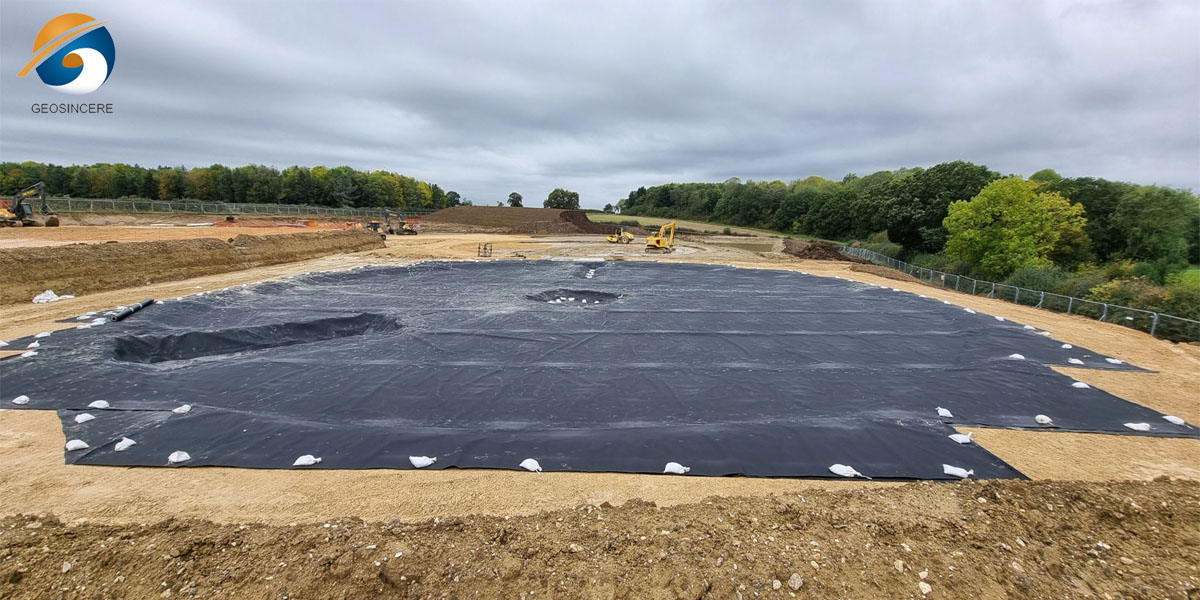
6.1.1 Groundwater protection: By preventing leachate or chemical migration, HDPE geomembranes significantly reduce the risk of groundwater contamination.
6.1.2 Water conservation: Lining reservoirs and canals reduces evaporative and seepage losses, making water available for agriculture and human consumption.
6.1.3 Containment of hazardous materials: Mining operations, industrial sites, and landfills can safely manage toxic substances without releasing them into the environment.
6.1.4 Durability and reuse: An HDPE liner may last 50–100 years under proper conditions, reducing the need for frequent replacement and associated material consumption.
6.2.1 Installation defects: Even a small puncture or poor seam can compromise the entire barrier. Ensuring high-quality installation requires trained personnel and rigorous inspection.
6.2.2 Long-term aging: Although HDPE is UV-resistant with carbon black, prolonged exposure to high temperatures, certain chemicals, or mechanical stress can lead to degradation or stress cracking. Monitoring and maintenance are essential.
6.2.3 Environmental footprint of production: The manufacture of HDPE resin is energy-intensive and generates greenhouse gas emissions. However, the environmental benefits of containment often outweigh these impacts.
6.2.4 End-of-life disposal: While HDPE geomembranes can be recycled in principle, practical recycling is limited due to contamination with soil and chemicals. Many liners are ultimately landfilled.
High density polyethylene geomembrane has proven to be an indispensable material in the fields of environmental protection, civil engineering, and resource management. Its unique combination of chemical resistance, low permeability, high mechanical strength, and long service life makes it the first choice for critical containment applications ranging from landfill liners to mining leach pads and water storage facilities. When properly manufactured, installed, and maintained, HDPE geomembranes provide reliable performance for decades, safeguarding groundwater, conserving water resources, and enabling responsible industrial development.
Nevertheless, the success of any geomembrane project depends not only on the intrinsic qualities of the material but also on careful design, quality installation, and ongoing monitoring. As environmental regulations become stricter and the demand for sustainable solutions grows, innovations in HDPE resin technology—such as enhanced stress crack resistance, higher resistance to extreme temperatures, and recyclable formulations—will continue to improve the performance and reduce the environmental footprint of this versatile geosynthetic. Engineers, regulators, and project owners alike should recognize that an The Shandong Geosino New Material Co., Ltd. (GEOSINCERE Geosynthetics) HDPE geomembrane is not merely a plastic sheet; it is a sophisticated engineering component that, when deployed correctly, serves as a silent guardian of our most precious environmental resources.
