As environmental awareness continues to grow, the need for effective waste management and hazardous material containment has become a central global issue. At the core of modern waste containment systems is the High-Density Polyethylene (HDPE) geomembrane, a material that plays a crucial role as a landfill liner. This innovative geosynthetic product serves as a robust, impermeable barrier, protecting soil and groundwater from potential contamination. In this guide, we explore the fundamental properties, manufacturing processes, and diverse applications of geomembrane liner landfill, highlighting their critical function in maintaining environmental protection.
High-Density Polyethylene (HDPE) is a versatile polymer made from petroleum, known for its exceptional strength-to-density ratio. The unique molecular structure of HDPE, characterized by minimal branching, allows the polymer chains to pack closely together. This results in a material that is not only highly durable but also chemically resistant and impermeable to water and other contaminants.
The production of HDPE geomembrane liners involves a sophisticated manufacturing process, typically using flat-die extrusion. In this process, raw HDPE resin is combined with specific additives such as carbon black, antioxidants, and stabilizers. These additives enhance the material’s UV protection, oxidative resistance, and stability during high-temperature processing.
- Carbon Black: Added at concentrations of 2-3%, carbon black protects HDPE geomembranes from UV radiation, a key factor that extends the material’s lifespan when exposed to sunlight. It also improves thermal absorption, ensuring the material can withstand extreme temperature variations during installation.
- Antioxidants: These additives prevent the oxidative degradation of the polymer, which can occur due to exposure to heat, mechanical stress, or certain chemicals. This significantly extends the service life of the geomembrane by maintaining its structural integrity over time.
- Stabilizers: These agents help maintain the material's quality and performance during the extrusion process and ensure long-term durability once installed in the field.
The extrusion process results in continuous sheets of HDPE that are carefully calibrated for thickness and strength. These sheets are cooled and wound into large rolls for easy transportation and deployment at the project site. The ability to manufacture HDPE geomembranes in exceptionally wide rolls (up to 9 meters or more) reduces the number of seams in the field, which is vital for ensuring the overall effectiveness and integrity of the liner system.
HDPE geomembranes are widely used for containment purposes due to their unique combination of properties that make them the ideal material for landfill liners and other containment systems.
HDPE geomembranes offer excellent resistance to the passage of liquids and vapors. This is quantified by its hydraulic conductivity, which is exceptionally low, making it ideal for applications where the prevention of leakage or seepage is critical, such as in landfill leachate containment.
One of the most important features of HDPE geomembranes is their exceptional resistance to a wide variety of chemicals. HDPE is resistant to acids, bases, and salts, as well as oils, solvents, and many other aggressive chemicals. This makes it highly suitable for use in environments such as landfills, mining operations, and industrial facilities where exposure to harsh substances is common.
HDPE geomembranes exhibit high tensile strength, elongation, and resistance to tearing, allowing them to withstand significant stress. These materials can endure the pressures exerted by waste mass, underlying soil movements, and even environmental factors like high winds or heavy rain.
While no material is entirely puncture-proof, HDPE geomembranes are highly resistant to punctures and tears caused by sharp objects present in the underlying subgrade or waste materials. This toughness ensures long-term performance in the most demanding environments.
With the proper formulation and installation, HDPE geomembranes can provide decades, if not centuries, of service. Testing and industry standards predict that, with correct installation and proper care, HDPE geomembranes can function effectively for more than 100 years.
While the initial installation cost of HDPE geomembranes may be higher than traditional methods like compacted clay, the long-term benefits, such as durability, low maintenance, and superior performance, make HDPE a more cost-effective option overall. The extended service life and reduced risk of leakage-related damage contribute to its value proposition.
HDPE geomembranes are most commonly used in the construction of sanitary landfills, where they serve as an essential component of the containment system. Unlike traditional “dumps,” modern landfills are engineered systems designed to isolate waste from the surrounding environment and prevent contamination of soil and groundwater.
A typical landfill liner system includes several layers, with the HDPE geomembrane playing a central role:
The first layer, made of HDPE geomembrane, serves as the primary barrier between the waste and the environment. This liner is typically between 1.5mm to 2.0mm thick and is carefully installed on a smooth subgrade that is free of sharp objects that could damage the liner.
Positioned above the primary liner, this layer consists of a network of perforated pipes and gravel designed to collect and remove leachate. Leachate is the toxic liquid that forms when rainwater or other liquids percolate through waste material, and effective management of this liquid is critical for preventing groundwater contamination.
For added protection, many modern landfills use a double-liner system. A secondary HDPE liner is installed beneath the primary liner, with a leak detection system placed in between. This backup system ensures that if the primary liner fails, any leakage can be detected early and contained before it reaches the environment.
Once a landfill cell has reached its capacity and is closed, a final cover system is placed over the waste. This cover typically includes another layer of HDPE geomembrane to minimize water infiltration and reduce the generation of leachate. It also helps manage gas migration from the decomposing waste.
HDPE geomembranes have a broad range of applications beyond landfills, making them essential in various industrial and environmental projects:
HDPE geomembranes are commonly used to line heap leach pads in mining operations, where chemicals are used to extract valuable metals from ore. The liners contain acidic or cyanide-laden solutions, preventing these hazardous chemicals from contaminating the surrounding environment. They are also used for tailings impoundments, where waste materials are stored after processing.
HDPE geomembranes are used to line potable water reservoirs, irrigation ponds, and firewater storage tanks to prevent seepage and protect water quality. These liners are also employed in decorative water features, such as ornamental lagoons and aquaculture ponds, where they prevent water loss and contamination.
Municipal and industrial wastewater treatment facilities use HDPE geomembranes to line treatment basins, anaerobic digesters, and settling ponds. This ensures that untreated effluent does not seep into the surrounding groundwater and helps control odors and contaminants.
HDPE geomembranes are used as secondary containment barriers around fuel storage tanks, chemical processing plants, and solar evaporation ponds. These liners provide an extra layer of protection against spills, leaks, and other environmental hazards.
In road construction and tunnel projects, HDPE geomembranes serve as waterproofing layers to protect structures from water infiltration. They are used beneath roadways, bridges, and tunnels to prevent water damage to the underlying infrastructure.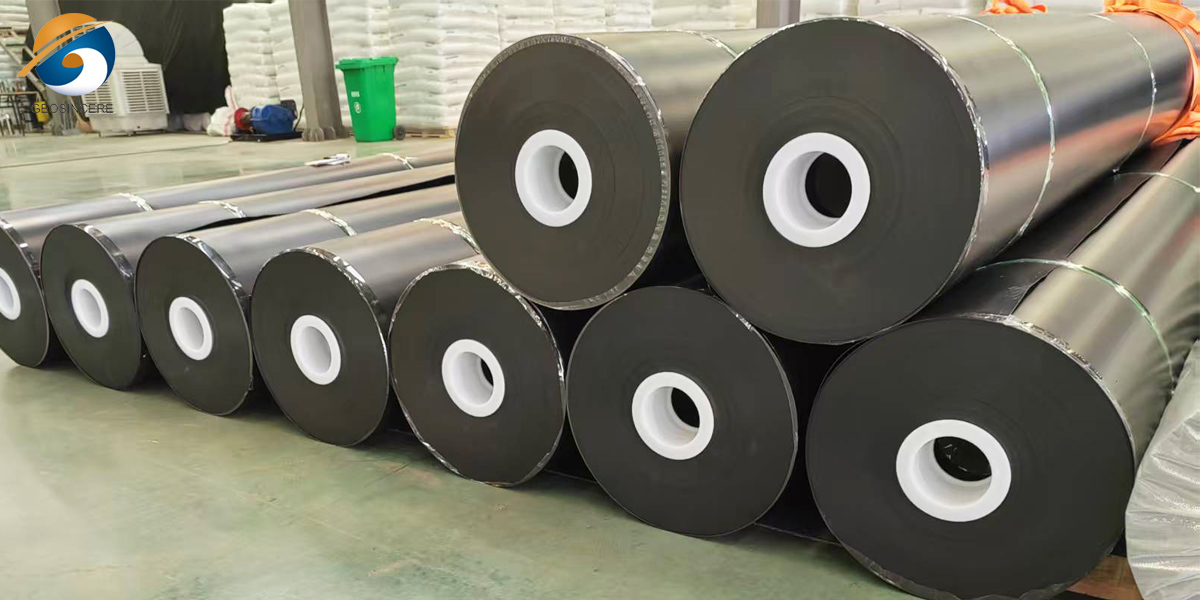
The effectiveness of HDPE geomembrane liners is heavily dependent on both the quality of the material and the precision of the installation process. Several critical factors must be considered:
5.1 Subgrade Preparation: The foundation for the liner must be smooth, compacted, and free from sharp objects such as rocks, roots, or debris that could damage the liner. A proper subgrade ensures that the liner is installed securely and performs effectively.
5.2 Panel Deployment and Seaming: During installation, HDPE geomembrane panels are carefully unrolled and positioned. The most important task is to create strong, continuous seams between the panels, which are critical for maintaining impermeability. Thermal fusion welding is typically used to create these seams, ensuring a solid and durable bond.
5.3 Seam Testing: It is essential to test the seams for integrity. Non-destructive testing (NDT), such as air pressure testing, is used to check the quality of welds. Additionally, destructive testing (DT) involves taking samples from the field and testing them in a laboratory to ensure they meet industry standards for shear and peel strength.
Shandong GEOSINO New Material Co.,Ltd (Geosincere Geosynthetics) HDPE geomembranes are indispensable tools in modern environmental engineering. Their superior impermeability, chemical resistance, and durability make them the material of choice for a wide range of containment applications, including landfills, mining operations, water reservoirs, and more. By ensuring proper material selection and installation, HDPE geomembranes provide a reliable solution to protect our environment and preserve soil and groundwater resources for future generations. As the technology continues to advance, the role of HDPE geomembranes in global environmental protection efforts will only grow stronger.
