In contemporary waste management, a HDPE pond liner for landfills is greater than simply a covering—it is the fundamental barrier protecting soil and groundwater from hazardous leachate. Landfills need to confine large quantities of waste for decades, and the preference of liner gadget determines their long-term safety. Among all materials, the HDPE geomembrane stands out as the enterprise widespread for landfill containment due to its durability, chemical resistance, and verified performance. Let’s discover the seven most essential blessings that make it indispensable.
The HDPE Pond Liner for Landfills is a high-performance geomembrane particularly engineered for long-term environmental containment. Manufactured from top class High-Density Polyethylene (HDPE) resins, it provides extraordinary chemical resistance, exquisite durability, and optimum impermeability, making it the industry’s desired preference for present day landfill applications.
Designed to act as a strong barrier system, this liner prevents leachate migration, defending groundwater and surrounding soil from contamination. It is an crucial issue of landfill base and capping systems, assembly stringent global first-rate requirements such as GRI GM13 and ASTM specifications.
Using an HDPE pond liner in landfill development appreciably reduces environmental risk, ensures regulatory compliance, and presents fee financial savings over the project’s lifecycle. Its skinny profile in contrast to compacted clay liners minimizes earthwork requirements, whilst its validated overall performance lowers the threat of luxurious remediation.
GEOSINCERE Geosynthetics manufactures and elements HDPE Pond Liners for Landfills with personalized thicknesses, widths, and roll lengths to swimsuit task specifications. Every roll undergoes rigorous first-rate inspection to make certain constant overall performance in the most difficult landfill environments.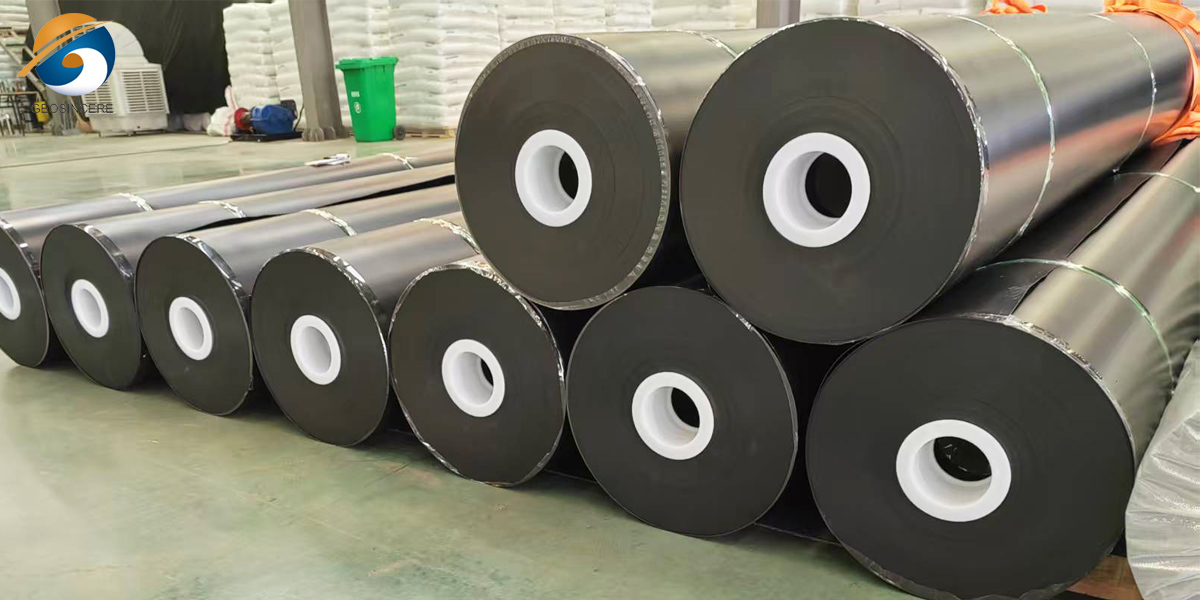
Landfill leachate is a complicated liquid combination generated as rainwater and different beverages percolate thru waste layers. It incorporates a fantastically variable aggregate of chemical compounds such as sturdy acids, alkalis, heavy metals, solvents, salts, natural compounds, and microbial life. These supplies can be extremely corrosive and unfavorable to many materials. Inferior liners may also degrade, swell, crack, or lose barrier integrity over time, main to infection of surrounding soil and groundwater.
HDPE geomembrane liner is composed of chemically inert polymers with a non-polar molecular structure, which means they withstand interplay with aggressive chemical substances in leachate. This inertness prevents bodily and chemical breakdowns such as swelling, dissolution, or cracking. The liner can preserve structural integrity and impermeability even after extended publicity to harsh landfill leachate environments. Additionally, HDPE is resistant to oxidation and hydrolysis, frequent reasons of polymer degradation. Multiple standardized tests, consisting of EPA Method 9090 and ASTM chemical resistance tests, have again and again established HDPE’s gold standard chemical stability, making it the most secure desire for long-term landfill containment.
Landfill liner is no longer brief solutions; they need to operate efficaciously for many years or even centuries. During this time, liners face publicity to ultraviolet (UV) radiation all through set up or earlier than remaining covering, floor motion and settlement, mechanical stresses, and organic elements such as fungi, bacteria, rodents, and insects. Any loss of liner overall performance compromises environmental protection and will increase remediation costs.
HDPE geomembranes are particularly formulated with UV stabilizers such as wonderful carbon black (typically 2-3%) that shield the polymer from degradation brought about with the aid of daylight exposure. This ensures that liners can face up to UV radiation at some stage in set up and earlier than closing soil cowl placement barring brittleness or cracking. Moreover, HDPE demonstrates super stress crack resistance, a measure of its potential to face up to cracking beneath long-term mechanical stresses. It additionally resists organic attacks, in contrast to some natural or composite substances susceptible to rot and pest damage. Produced underneath stringent fantastic manipulate requirements (ASTM, GRI), HDPE liners make sure uniform thickness and defect-free structure, which interprets into long-lasting, dependable overall performance for landfill projects.
The core cause of landfill liners is to stop hazardous leachate and contaminants from migrating into the environment. Even small leaks over massive areas and lengthy time durations can end result in substantial soil and groundwater pollution. The liner should provide near-zero permeability to drinks and gases.
HDPE geomembranes possess an extraordinarily low permeability coefficient—commonly beneath 1 × 10⁻¹³ cm/s—which makes them in reality impermeable to drinks and gases. This overall performance degree appreciably exceeds that of herbal compacted clay liners, which require full-size thickness to attain similar impermeability. When HDPE sheets are thermally welded with precision, the seams keep the equal low permeability, making sure a non-stop barrier. This property is imperative in defending ecosystems and complying with environmental regulations. The liner additionally efficiently blocks vapor transmission, minimizing the hazard of fuel emissions and smell release.
During landfill building and waste placement, liners should stand up to mechanical stresses from heavy machinery, sharp objects within waste, and uneven load distribution. Punctures, tears, or tears can compromise containment, main to high-priced repairs and environmental hazards.
HDPE geomembranes provide high tensile power in each computing device and cross-machine directions, permitting them to withstand stretching and tearing beneath heavy loads. ASTM-standard checks such as D4833 (puncture resistance) and D1004 (tear resistance) verify their strong mechanical properties. Thicker HDPE liners (1.5mm and above, frequent in landfill applications) supply more advantageous safety in opposition to punctures precipitated through stones, debris, or equipment. The cloth additionally has exquisite have an impact on resistance, absorbing shocks except cracking. This aggregate of energy and sturdiness makes HDPE liners pretty appropriate for difficult landfill environments.
Landfill covers span massive areas, requiring a couple of geomembrane panels to be joined on site. Weak seams characterize a quintessential failure risk, doubtlessly permitting leakage pathways.
HDPE liners are perfect for thermal fusion welding, which produces strong, monolithic, watertight seams. The two essential welding methods used are:
- Dual Hot Wedge Welding: Creates two parallel weld beads with an air channel in between for nondestructive seam testing.
- Extrusion Welding: Used for complicated details, patches, and repairs.
These seams bear rigorous checking out — each negative (peel, shear tests) and nondestructive (vacuum box, air channel strain testing) — to affirm integrity. Such exceptional assurance ensures the liner machine features as a continuous, leak-proof barrier over the complete landfill area, getting rid of susceptible factors and growing common reliability.
The floor floor below a landfill liner is not often uniform or stable. Differential settlement, roughness, and minor actions happen over time. A liner should adapt except bridging voids or growing stress concentrations that lead to tearing or puncture.
HDPE geomembrane mix excessive power with ample flexibility to conform intently to organized subgrades. This flexibility approves the liner to comply with floor contours and accommodate minor differential settlements besides dropping barrier function. Proper subgrade preparation—ensuring smooth, compacted, debris-free surfaces—and use of geotextile safety layers decorate this conformability. The material’s elasticity prevents the formation of stress points, lowering the chance of injury in the course of set up and operational life, thereby retaining long-term containment effectiveness.
The usual price of a landfill liner consists of no longer solely cloth buy however additionally installation, maintenance, attainable repairs, and danger of failure main to environmental remediation. A more cost-effective upfront choice can show greater luxurious over time.
While the preliminary price of HDPE geomembrane liners may also be greater than some alternatives, their lengthy carrier existence and sturdiness reduce substitute and restore costs. Compared to thick compacted clay liners, HDPE requires much less earthwork and affords most reliable impermeability in a thinner profile. Efficient set up strategies and excessive seam reliability decrease labor and inspection expenses. Moreover, the danger mitigation furnished by means of HDPE’s confirmed overall performance lowers plausible environmental liability, which can be financially devastating. The internet end result is a pretty economical answer supplying great financial savings and peace of thought for the duration of the landfill’s operational and post-closure phases.
Even the highest-quality HDPE geomembrane for landfills performs at its pleasant solely with:
- Well-prepared subgrades free from debris.
- Skilled set up by means of licensed crews.
- Comprehensive nice manage for seams and material.
- Protective layers above and beneath the liner.
A HDPE pond liner for landfills is the spine of tremendous waste containment. Combining great chemical resistance, intense durability, near-zero permeability, excessive strength, dependable seams, adaptability, and fee efficiency, HDPE geomembranes grant unparalleled safety for landfill initiatives worldwide. When safeguarding environmental sources is non-negotiable, selecting GEOSINCERE Geosynthetics ensures a liner answer that provides safety, performance, and price for decades.
